
Aug 7, 2026News Center
100G Optical Transceivers for Data Centers | QSFP28 Guide
Learn how 100G optical transceivers power modern data centers. Explore QSFP28 SR4, LR4, CWDM4, DR4 modules, applications, compatibility, and selection tips.
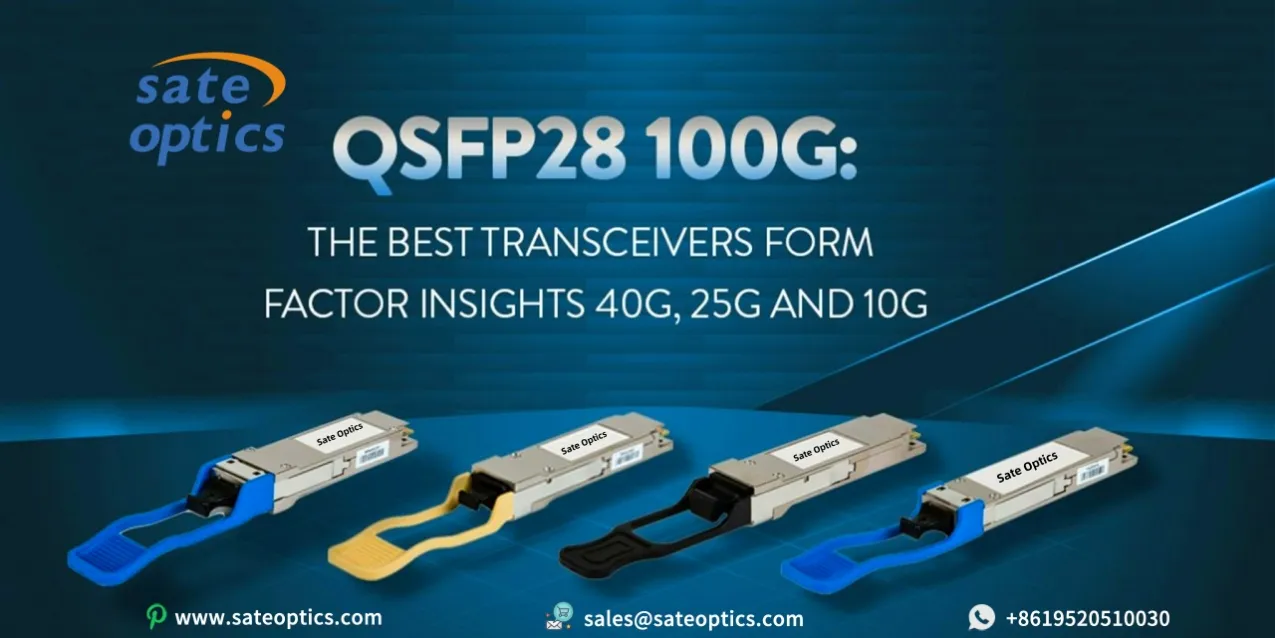
100G Optical Transceivers for Data Centers: Complete Guide to QSFP28 Modules, Applications, and Deployment
Why 100G Optical Transceivers Are Critical for Modern Data Centers
Modern data centers are experiencing unprecedented growth driven by cloud computing, artificial intelligence, virtualization, video streaming, and enterprise digital transformation.
As network traffic continues increasing, traditional 10G and 25G connections are becoming insufficient for many high-performance environments.
100G optical transceivers have become a key technology for upgrading backbone networks, connecting data center switches, and supporting high-bandwidth applications.
From enterprise data centers to hyperscale cloud environments, 100G QSFP28 optical modules provide the speed, flexibility, and scalability required for next-generation network infrastructures.
This guide explains:
- What 100G optical transceivers are
- Common 100G QSFP28 module types
- How to choose the right 100G optics
- Typical data center applications
- Compatibility considerations
- Frequently asked questions before deployment
What Are 100G Optical Transceivers?
A 100G optical transceiver is a high-speed networking component that converts electrical signals from switches or routers into optical signals transmitted through fiber optic cables.
Most 100G optical modules use the QSFP28 form factor, which provides:
- 100Gbps data transmission
- Compact design
- Lower power consumption
- High port density
- Compatibility with modern data center switches
Compared with older 40G solutions, 100G QSFP28 modules provide higher bandwidth while maintaining similar physical dimensions.
Common applications include:
- Leaf-spine data center networks
- Server aggregation
- Switch-to-switch connections
- Data center interconnect (DCI)
- Cloud infrastructure
Common Types of 100G QSFP28 Optical Transceivers
Different data center architectures require different transmission distances and fiber types.
The most common 100G optical modules include:
1. QSFP-100G-SR4: 100G Short Reach Multimode Optical Module
The QSFP-100G-SR4 is designed for short-distance data center connections.
Typical specifications:
- Wavelength: 850nm
- Fiber type: Multimode fiber (MMF)
- Connector: MPO-12
- Distance: Up to 70m on OM3 / 100m on OM4
Common applications:
- Server-to-switch connections
- Top-of-rack (ToR) switching
- High-density data center environments
For customers deploying short-distance 100G links inside data halls, QSFP-100G-SR4 remains one of the most widely used solutions.
2. QSFP-100G-LR4: 100G Long Reach Single Mode Module
The QSFP-100G-LR4 is designed for longer transmission distances.
Typical specifications:
- Wavelength: 1310nm
- Fiber type: Single mode fiber (SMF)
- Connector: Duplex LC
- Distance: Up to 10km
Applications include:
- Data center interconnect
- Campus networks
- Enterprise backbone networks
Compared with SR4, LR4 provides significantly longer reach and works with standard single-mode fiber infrastructure.
3. QSFP-100G-CWDM4: Cost-Effective Data Center Interconnect Solution
The 100G CWDM4 optical module is widely used for data center applications requiring longer distances than SR4 but lower cost than LR4.
Typical specifications:
- Wavelength: CWDM 1310nm range
- Fiber type: Single mode fiber
- Connector: Duplex LC
- Distance: Up to 2km
Advantages:
- Lower cost compared with LR4
- Uses existing duplex SMF cabling
- Suitable for modern cloud data centers
4. 100G DR4 and FR4 Optical Transceivers
With the development of AI clusters and high-performance computing, higher-density 100G solutions are becoming increasingly important.
100G DR4
Features:
- Single wavelength 100G
- Parallel single-mode fiber
- MPO connector
- Up to 500m transmission
100G FR4
Features:
- Four wavelength CWDM technology
- Duplex LC connector
- Up to 2km transmission
These modules are often used in advanced data center architectures requiring efficient fiber utilization.
100G Optical Transceiver Applications in Data Centers
1. Leaf-Spine Network Architecture
Modern data centers commonly use leaf-spine architecture to improve scalability and reduce latency.
100G optical modules are frequently deployed between:
- Leaf switches
- Spine switches
- Aggregation layers
For example:
Cisco Nexus 9000 Series + QSFP-100G-LR4-S
is a common deployment combination for enterprise and cloud environments.
Related topic:
Learn more about Cisco data center switching:
Cisco Catalyst vs Nexus Switches
2. Data Center Interconnect (DCI)
Large enterprises often operate multiple data centers.
100G optical modules enable high-speed connections between locations.
Typical requirements:
- Long transmission distance
- Stable optical performance
- Low latency
Common solutions:
- QSFP-100G-LR4
- 100G ER4
- 100G DWDM modules
3. Cloud Computing and AI Infrastructure
Cloud platforms and AI workloads require extremely high bandwidth.
100G networks are often used for:
- Storage networks
- GPU cluster connections
- High-performance computing
- Distributed applications
Reliable optical modules help maintain:
- Low packet loss
- Stable optical power
- Continuous operation
How to Choose the Right 100G Optical Transceiver?
Before selecting a 100G optical module, consider the following factors:
1. Transmission Distance
Choose according to link distance:
- Within 100m → QSFP-100G-SR4
- 100m–2km → QSFP-100G-CWDM4 / FR4
- Up to 10km → QSFP-100G-LR4
2. Fiber Type
Different modules require different fiber:
Multimode Fiber (MMF)
Suitable for:
- Short-distance connections
- Data center racks
Single Mode Fiber (SMF)
Suitable for:
- Long-distance transmission
- Campus networks
- DCI applications
Recommended reading:
MMF vs SMF Fiber: Complete Guide for Optical Transceiver Selection
3. Switch Compatibility
Optical compatibility is one of the biggest concerns during deployment.
100G modules must match:
- Switch brand
- Model number
- Firmware requirements
- Coding information
Common compatible platforms include:
- Cisco
- Juniper
- Arista
- Huawei
- HPE
- Dell EMC
Examples:
- QSFP-100G-SR4-S compatible with Cisco Nexus switches
- QSFP-100G-LR4-S compatible with Cisco enterprise networks
Why Choose Sate Optics 100G Compatible Optical Transceivers?
Choosing compatible optics can significantly reduce network deployment costs while maintaining reliable performance.
Sate Optics provides:
✅ Cisco compatible 100G QSFP28 modules
✅ Juniper / Arista / Huawei compatible solutions
✅ 100% tested before shipment
✅ DDM monitoring support
✅ Customized coding according to customer requirements
✅ Stable supply chain since 2004
Each module is tested for:
- Optical power
- Wavelength accuracy
- BER performance
- Compatibility validation
Common Problems When Deploying 100G Optical Modules
1. Unsupported Transceiver Alarm
Some switches may display:
"Unsupported Transceiver"
Possible reasons:
- Incorrect EEPROM coding
- Firmware restrictions
- Compatibility mismatch
Solution:
Choose properly coded compatible modules and verify platform requirements.
Related article:
How to Fix SFP Compatibility Issues
2. High Optical Loss
Possible causes:
- Dirty fiber connectors
- Poor-quality patch cords
- Excessive fiber attenuation
Solutions:
- Clean connectors
- Check optical power
- Verify link budget
3. Incorrect Fiber Selection
Example:
Using QSFP-100G-SR4 with single-mode fiber will cause compatibility problems.
Always confirm:
- Fiber type
- Connector type
- Transmission distance
FAQ: 100G Optical Transceivers for Data Centers
1. What is a 100G optical transceiver?
A 100G optical transceiver is a networking module that provides 100Gbps data transmission between switches, routers, and other network equipment using fiber optic cables.
2. What is the most common 100G optical module?
The most widely deployed 100G optical module is QSFP28, including QSFP-100G-SR4, QSFP-100G-LR4, and QSFP-100G-CWDM4.
3. What is the difference between QSFP-100G-SR4 and LR4?
SR4 uses multimode fiber for short distances, while LR4 uses single-mode fiber for distances up to 10km.
4. Can third-party 100G optical modules work with Cisco switches?
Yes. Cisco-compatible QSFP28 modules can work with Cisco switches when properly coded and tested.
5. How do I select a 100G transceiver for my data center?
Consider:
- Distance
- Fiber type
- Switch compatibility
- Connector type
- Network architecture
6. Are compatible 100G optical modules reliable?
High-quality compatible modules can provide similar performance to OEM optics when they are properly tested and coded.
Conclusion: Building Future-Proof Data Centers with 100G Optics
100G optical transceivers have become a fundamental component of modern data center networks.
Whether deploying:
- Cisco Nexus networks
- Enterprise data centers
- Cloud infrastructure
- AI computing clusters
choosing the correct QSFP28 optical module is essential for network reliability and scalability.
By understanding transmission distance, fiber type, compatibility requirements, and application scenarios, network teams can build efficient and cost-effective 100G infrastructures.
Get Reliable 100G Optical Transceivers from Sate Optics
Looking for Cisco compatible QSFP-100G-SR4, QSFP-100G-LR4, QSFP-100G-CWDM4, or customized 100G optical solutions?
Contact Sate Optics for:
✅ Compatibility consultation
✅ Technical support
✅ Sample testing
✅ Competitive pricing
Upgrade your data center network with reliable 100G optical transceiver solutions today.
Related Articles
1. Cisco Catalyst vs Nexus Switches: Which One Should You Choose?
Learn the differences between Cisco enterprise and data center switches, including deployment scenarios and optical module requirements.
2. Optical Transceivers for Data Centers: Complete Deployment Guide
Understand how SFP, SFP+, QSFP28, and high-speed optics support modern data center networks.
3. AOC vs DAC vs Optical Transceivers: How to Choose the Right Solution?
Compare active optical cables, direct attach cables, and optical modules for high-speed connections.
4. How to Choose a Reliable Optical Transceiver Supplier
Learn key factors including testing, compatibility, warranty, and technical support when selecting an optical supplier.
5. How to Troubleshoot Optical Module Problems
A practical guide covering optical power issues, compatibility errors, and link failures.