
Aug 4, 2026News Center
How to Choose a Reliable Optical Transceiver Supplier | Optical Module Buying Guide
Learn how to choose a reliable optical transceiver supplier for Cisco, Juniper, Arista, Huawei, and data centers. Explore compatibility, testing, quality control, warranty, and technical support.
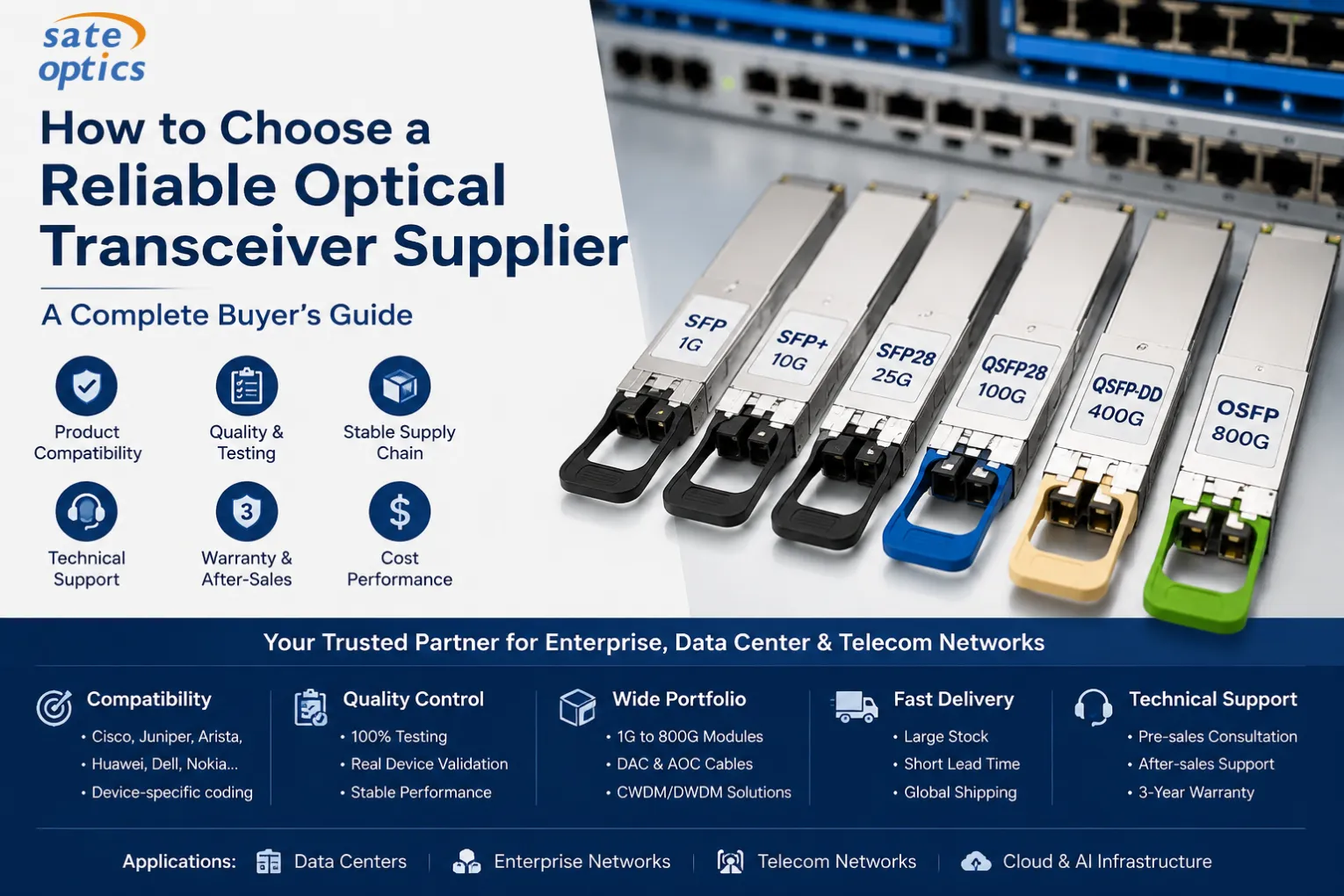
How to Choose a Reliable Optical Transceiver Supplier: A Complete Buyer’s Guide
Why Choosing the Right Optical Transceiver Supplier Matters
Optical transceivers are small components, but they play a critical role in modern network infrastructure.
From enterprise networks and telecom systems to hyperscale data centers, a single optical module failure can cause:
- Network downtime
- Packet loss
- Link instability
- Expensive troubleshooting
- Project deployment delays
When companies purchase optical modules, the lowest price is rarely the only factor that matters.
A reliable optical transceiver supplier should provide:
✅ Stable product quality
✅ Accurate device compatibility
✅ Strict testing procedures
✅ Fast delivery capability
✅ Technical support
✅ Long-term supply stability
Whether you are deploying Cisco switches, Juniper routers, Arista data center switches, Huawei telecom equipment, or Dell networking platforms, choosing the right optical supplier directly impacts network reliability.
1. Check Optical Transceiver Compatibility Before Buying
One of the biggest challenges when sourcing optical modules is compatibility.
Different network vendors use different coding requirements.
For example:
- Cisco switches may require Cisco-coded transceivers
- Juniper devices may require Juniper-compatible EEPROM programming
- Arista switches may have specific DOM and firmware requirements
- Huawei and Nokia telecom equipment may require customized coding
A professional optical transceiver supplier should provide modules that are:
✅ Compatible with original equipment specifications
✅ Programmed according to customer requirements
✅ Tested on real networking platforms
Common compatible models include:
Cisco Compatible Optical Transceivers
- GLC-SX-MMD
- GLC-LH-SMD
- GLC-EX-SMD
- SFP-10G-SR
- SFP-10G-LR
- SFP-25G-SR
- QSFP-40G-SR4
- QSFP-100G-SR4-S
- QSFP-100G-LR4-S
- QSFP-100G-DR-S
A reliable supplier should understand not only optical specifications but also switch compatibility.
2. Evaluate Product Quality and Testing Standards
Many optical modules look identical externally, but internal quality can vary significantly.
A professional supplier should have a complete quality control process.
Important testing items include:
Optical Performance Testing
Including:
- TX optical power
- RX sensitivity
- Extinction ratio
- Wavelength accuracy
- Eye diagram testing
Network Compatibility Testing
Testing should include real devices such as:
- Cisco Catalyst switches
- Cisco Nexus data center switches
- Juniper EX/QFX series
- Arista 7050/7280 series
- Huawei CloudEngine switches
Environmental Testing
Reliable suppliers should also verify:
- Temperature performance
- Voltage stability
- Long-term operation reliability
For high-speed modules such as:
- 100G QSFP28
- 400G QSFP-DD
- 800G OSFP
testing becomes even more important because of higher power consumption and thermal challenges.
3. Choose a Supplier With Complete Product Coverage
A professional optical transceiver supplier should support different network requirements.
Enterprise Network Applications
Common modules:
- 1G SFP SX/LX
- 10G SFP+ SR/LR
- 25G SFP28 SR/LR
Typical devices:
- Cisco Catalyst 9300
- Cisco Catalyst 9500
- Juniper EX switches
Data Center Applications
Common modules:
- 40G QSFP+
- 100G QSFP28
- 400G QSFP-DD
- 800G OSFP
Applications:
- Leaf-spine architecture
- AI clusters
- Cloud computing
- High-performance computing
Telecom and Long-Distance Networks
Common solutions:
- CWDM optical modules
- DWDM modules
- 100G coherent optics
- Long-distance single-mode transceivers
Applications:
- Metro networks
- ISP backbone
- Data center interconnection
A supplier with a complete product portfolio can help customers avoid sourcing from multiple vendors.
4. Verify Supply Chain Stability and Inventory Capability
Network projects often have strict deployment schedules.
A supplier should be able to provide:
✅ Stable production capacity
✅ Short lead times
✅ Stock availability
✅ Consistent product revisions
For example:
A data center upgrade may require hundreds or thousands of:
- SFP-10G-LR
- SFP-25G-SR
- QSFP-100G-LR4
- QSFP-DD-400G-DR4
A reliable supplier should support both:
- Small engineering samples
- Large-scale enterprise deployment
5. Consider Warranty and Technical Support
Optical transceivers are not simply commodity products.
Professional technical support can reduce troubleshooting time.
A reliable supplier should provide:
Before Purchase Support
Including:
- Module selection
- Distance planning
- Fiber type recommendation
- Compatibility confirmation
Example:
Should you choose:
SFP-10G-SR or SFP-10G-LR?
It depends on:
- Fiber type
- Transmission distance
- Network architecture
Related guide:
👉 Internal Link:
SFP-10G-SR vs LR: Which 10G Optical Module Should You Choose?
After Purchase Support
Including:
- Compatibility troubleshooting
- DOM value analysis
- Replacement service
- Technical consultation
6. Compare OEM Optical Modules vs Compatible Optical Modules
Many customers evaluate:
Original OEM Modules
Advantages:
- Official branding
- Manufacturer support
Disadvantages:
- Higher cost
- Longer procurement cycles
Compatible Optical Modules
Advantages:
- Lower total cost
- Flexible sourcing
- Same industry standards
- Customized coding options
A professional compatible optical supplier should provide:
✅ OEM-equivalent performance
✅ Device-specific coding
✅ Full testing reports
✅ Warranty support
For many enterprise networks, compatible optical modules provide a better balance between performance and budget.
7. Choose a Supplier With Real Application Experience
The best suppliers understand network environments, not just product specifications.
A knowledgeable supplier should understand applications such as:
Data Center Migration
Example:
Replacing:
10G SFP+ → 25G SFP28 → 100G QSFP28
Requirements:
- Compatibility
- Fiber planning
- Migration strategy
Enterprise Campus Upgrade
Example:
Cisco Catalyst 9300 deployment
Required modules:
- GLC-SX-MMD
- SFP-10G-SR
- SFP-10G-LR
AI and Cloud Infrastructure
Example:
400G / 800G network deployment
Required:
- QSFP-DD 400G DR4
- OSFP 800G DR8
How Sate Optics Helps Customers Choose the Right Optical Supplier
At Sate Optics, we focus on providing reliable optical networking solutions for enterprise, telecom, and data center customers.
Our advantages include:
✅ Compatible optical transceivers for major brands
(Cisco, Juniper, Arista, Huawei, Dell, Nokia)
✅ Professional compatibility coding
✅ 100% testing before shipment
✅ Support for 1G to 800G optical solutions
✅ Flexible supply for both small projects and large deployments
Products include:
- SFP
- SFP+
- SFP28
- QSFP+
- QSFP28
- QSFP-DD
- OSFP
- DAC & AOC cables
FAQ: How to Choose a Reliable Optical Transceiver Supplier
1. What should I check before choosing an optical transceiver supplier?
You should evaluate:
- Product quality
- Compatibility testing
- Technical support
- Warranty policy
- Supply stability
- Customer experience
2. Are compatible optical modules reliable?
Yes, when purchased from a professional supplier.
High-quality compatible modules can provide similar performance to OEM modules when they are properly coded, tested, and manufactured according to industry standards.
3. How can I verify optical module compatibility?
Provide your:
- Switch model
- Router model
- Original part number
- Fiber type
- Transmission distance
A professional supplier can recommend the correct module.
4. Does a cheaper optical transceiver supplier always provide better value?
Not necessarily.
A low-cost module without proper testing may cause:
- Link failures
- Network instability
- Additional replacement costs
The best supplier provides the right balance between price, quality, and support.
5. Can one supplier provide optical modules for multiple brands?
Yes.
Many professional suppliers support:
- Cisco compatible optics
- Juniper compatible optics
- Arista compatible optics
- Huawei compatible optics
- Dell compatible optics
This simplifies procurement and supply management.
Conclusion: Choosing the Right Optical Supplier Reduces Network Risk
Selecting an optical transceiver supplier is not only about purchasing modules.
It is about choosing a long-term technology partner.
The right supplier should provide:
✅ Reliable compatibility
✅ Strict quality control
✅ Fast delivery
✅ Technical expertise
✅ Long-term support
For enterprise networks, telecom operators, and data centers, a reliable optical supplier helps ensure stable connectivity and successful network upgrades.
Need Reliable Optical Transceivers for Your Network?
Looking for compatible optical modules for Cisco, Juniper, Arista, Huawei, or other networking platforms?
Contact Sate Optics today for:
✅ Compatibility consultation
✅ Product recommendations
✅ Competitive pricing
✅ Technical support
Build a more reliable network with tested optical solutions.
👉 Contact us for your optical transceiver requirements.
Related Articles
1. Complete Guide to Cisco Optical Transceivers
Learn how Cisco-compatible optical modules work, including common models, compatibility considerations, and deployment scenarios.
2. Cisco Compatible Optical Transceivers Explained
Understand how third-party Cisco-compatible modules are coded, tested, and deployed in enterprise networks.
3. Optical Transceivers for Data Centers: Complete Guide
Explore how SFP, QSFP28, QSFP-DD, and OSFP modules support modern data center architectures.
4. AOC vs DAC vs Optical Modules: Which Solution Should You Choose?
Compare different high-speed connectivity solutions for servers, switches, and data center networks.
5. How to Troubleshoot Optical Modules: Common Problems and Solutions
Learn how to diagnose TX fault, RX power issues, compatibility alarms, and fiber connection problems.