
Jun 26, 2026News Center
AOC vs DAC vs Optical Modules
Learn the differences between AOC, DAC, and optical modules for data centers and enterprise networks. Optimize your network with the right high-speed connectivity solution.
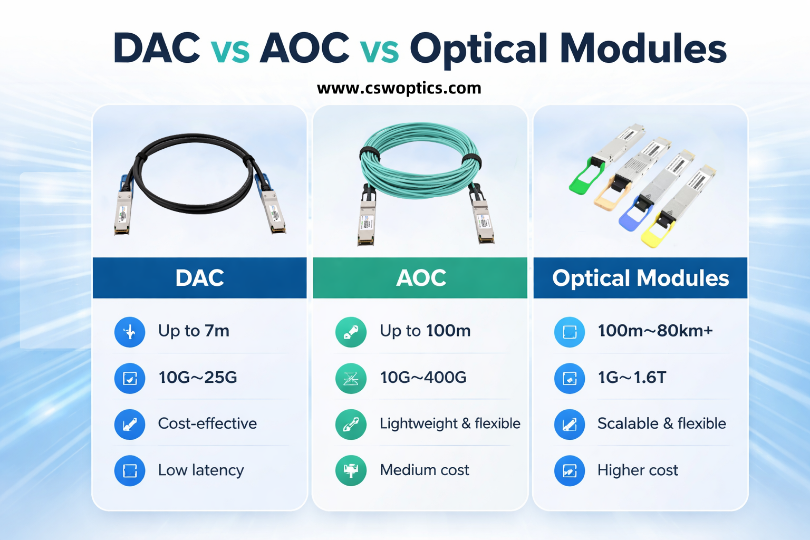
AOC vs DAC vs Optical Modules: Which is Right for Your Network?
Understanding High-Speed Connectivity: AOC, DAC, and Optical Modules
In modern data centers, cloud networks, and enterprise networks, high-speed connections are the backbone of efficient communication. Choosing the right interconnect technology is crucial for performance, cost-efficiency, and long-term scalability. Three popular solutions—AOC (Active Optical Cable), DAC (Direct Attach Copper), and Optical Modules—each have their unique strengths and limitations.
This guide will help you understand their differences, ideal use cases, and what to consider when planning your network upgrades.
🔹 What is DAC (Direct Attach Copper)?
DAC cables are twinax copper cables with transceivers integrated at both ends. They provide a plug-and-play solution for short-distance connections, usually up to 7 meters for 10G/25G links.
Advantages:
- Cost-effective: Lower price per link compared to optical solutions.
- Low latency: Near-zero signal delay.
- Energy-efficient: No additional power required.
Limitations:
- Short distance only; not suitable for long-range connections.
- Less flexible for upgrades to higher speeds beyond 100G.
Ideal use case: Rack-to-rack connections within a single data center row or top-of-rack (ToR) switches.
🔹 What is AOC (Active Optical Cable)?
AOC cables use optical fibers instead of copper and include transceivers at both ends. They are suitable for medium-distance connections, typically up to 100 meters, depending on the data rate.
Advantages:
- Longer reach than DAC without signal degradation.
- Lightweight and flexible, easier to manage in dense cabling environments.
- Supports high data rates from 10G to 400G.
Limitations:
- Slightly higher cost than DAC.
- Power is required for the active transceivers at both ends.
Ideal use case: Data center rows spanning multiple racks or switch-to-switch connections over tens of meters.
🔹 What are Optical Modules?
Optical transceivers (SFP, SFP+, SFP28, QSFP+, QSFP28, QSFP-DD, OSFP) convert electrical signals into optical signals, allowing long-distance connections over fiber optic cables.
Advantages:
- Ultra-long reach: From 100 meters to 80 kilometers depending on module type (SR, LR, ER).
- Scalable for high-speed networks: Supports 10G, 25G, 40G, 100G, 400G, and even 800G/1.6T networks.
- Flexible deployment: Can mix and match transceivers based on distance and protocol.
Limitations:
- Higher cost compared to DAC or AOC for short distances.
- Requires fiber patch panels and more careful cable management.
Ideal use case: Core network links, long-haul inter-data center connections, telecom networks.
🔹 Comparing DAC, AOC, and Optical Modules
Feature | DAC | AOC | Optical Modules |
|---|---|---|---|
Distance | Up to 7m | 7–100m | 100m–80km+ |
Speed | 10G–25G | 10G–400G | 1G–1.6T |
Cost | Lowest | Medium | Higher |
Power | Passive | Active | Active/Passive depending on module |
Flexibility | Low | Medium | High |
Best For | Short-range, rack-to-rack | Medium-range, high-speed | Long-range, scalable |
🔹 Key Considerations When Choosing
- Distance: How far apart are your devices? DAC is for short-range; AOC covers medium distances; optical modules are for long-range or mixed deployments.
- Budget: DAC is the most cost-efficient, AOC provides a balance, and optical modules are premium but future-proof.
- Data Rate: Ensure the technology supports your current and future speed requirements.
- Environment: Consider cable management, heat, and energy efficiency.
- Vendor Compatibility: Ensure modules and cables are compatible with your switches and routers.
🔹 FAQ — Common Questions
Q1: Can I mix DAC and AOC in the same network?
A: Yes, but ensure your switches support both types on the same interface type, and consider signal integrity and latency.
Q2: Which is more cost-effective for short-range connections?
A: DAC cables are the most affordable for distances under 7 meters.
Q3: Are optical modules future-proof for higher speeds?
A: Yes, optical modules support upgrades from 10G to 800G/1.6T, depending on module type.
Q4: Do AOC cables require special handling?
A: They are more flexible than fiber but should still avoid sharp bends and excessive pulling.
Q5: How do I know which optical module to choose?
A: Match the module type (SR, LR, ER, etc.) to your distance, switch compatibility, and speed requirement.
🔹 Ready to Upgrade Your Network?
Optimize your network performance today with high-quality DAC, AOC, and optical modules from SateOptics:
- ✅ Reliable & Tested for all major switch brands
- ✅ Supports 10G → 1.6T speeds
- ✅ Customized Solutions for your network needs
Take Action:
🔹 Browse our Optical Modules Catalog
🔹 Chat with our experts via WhatsApp: +8619520510030
🔹 Get a custom solution quote today
AOC vs DAC, Optical Modules, SFP, QSFP, High-speed network, Data center connectivity, 10G 25G 40G 100G 400G