
Jun 26, 2026News Center
Cisco DAC vs AOC: Which Cable Is Better for Data Centers?
Compare Cisco DAC and AOC cables in terms of cost, distance, power consumption, and deployment scenarios. Learn which solution is best for your data center network.
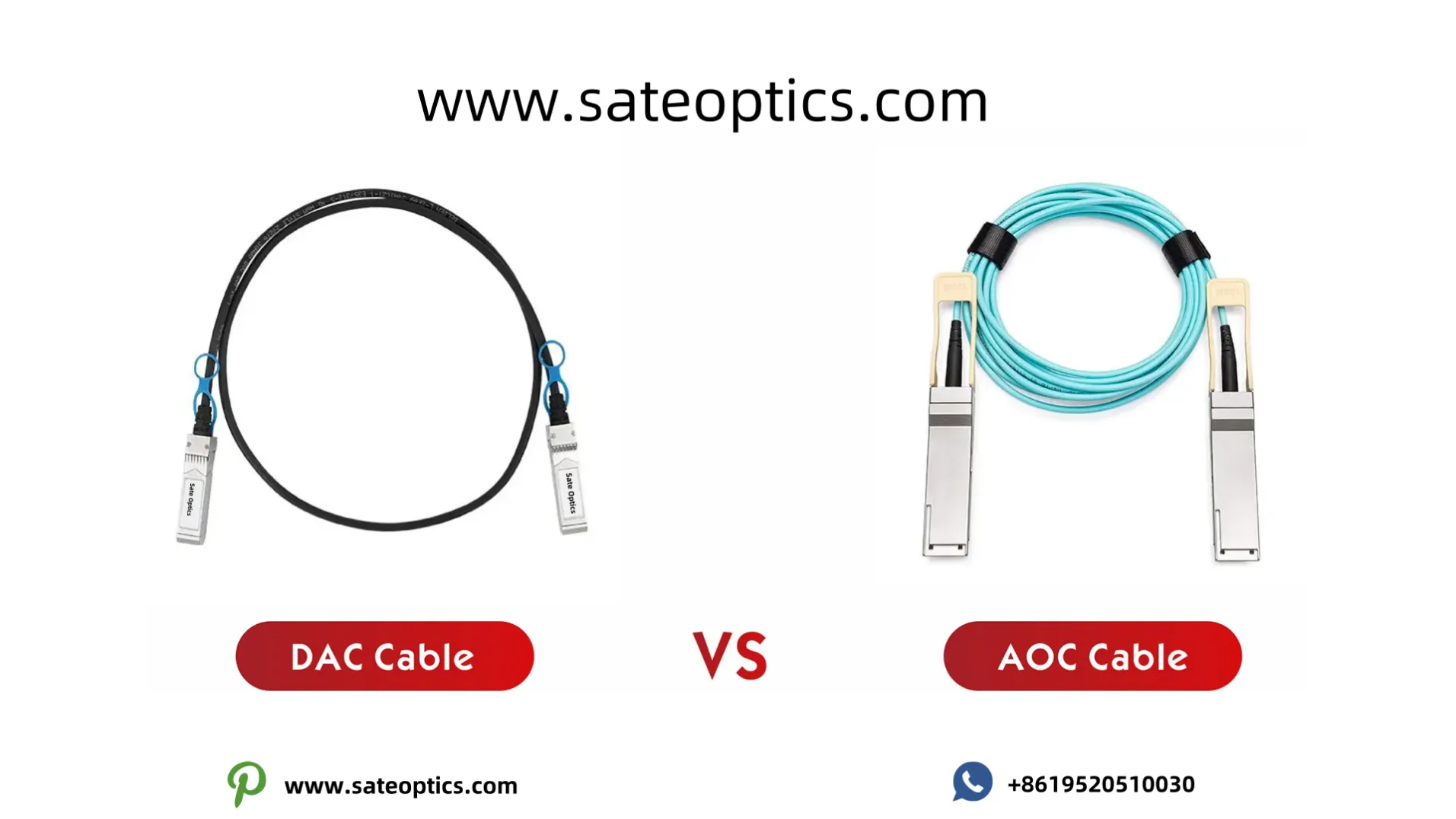
A Complete Guide to Cisco Compatible DAC and AOC Cables for Cost, Distance, Performance, and Deployment Scenarios
Cisco DAC vs AOC: Which One Should You Choose?
When building or upgrading a data center network, selecting the right connectivity solution is just as important as choosing switches and transceivers.
Many network engineers and procurement teams face the same question:
Should I use DAC cables or AOC cables?
Both solutions are widely deployed in Cisco environments and can deliver excellent performance. However, their ideal use cases, costs, and deployment flexibility are quite different.
In this guide, we'll compare Cisco-compatible DAC and AOC solutions to help you determine which option best fits your network infrastructure.
What Is a DAC Cable?
DAC (Direct Attach Copper) is a twinax copper cable with integrated transceivers permanently attached at both ends.
Unlike optical modules, DAC cables do not require separate transceivers or fiber patch cords.
Common Cisco-compatible DAC models include:
- SFP-H10GB-CU1M
- SFP-H10GB-CU3M
- SFP-H10GB-CU5M
- SFP-25G-CU1M
- SFP-25G-CU3M
- QSFP-H40G-CU1M
- QSFP-100G-CU2M
- QSFP-100G-CU3M
DAC cables are typically used for short-distance interconnections inside racks or between adjacent racks.
What Is an AOC Cable?
AOC (Active Optical Cable) combines optical transceivers and fiber cable into a single integrated assembly.
Internally, electrical signals are converted into optical signals, enabling much longer transmission distances compared with copper DAC cables.
Popular Cisco-compatible AOC models include:
- SFP-10G-AOC1M
- SFP-10G-AOC5M
- SFP-25G-AOC10M
- QSFP-40G-AOC10M
- QSFP-100G-AOC20M
- QSFP-100G-AOC30M
AOCs are widely used for Top-of-Rack (ToR), End-of-Row (EoR), and Spine-Leaf architectures.
DAC vs AOC: Key Differences
Typical Reach Comparison
Common maximum deployment distances for data center interconnects.
0m30m60m90m120mPassive DACActive DACAOC
Feature | DAC | AOC |
|---|---|---|
Transmission Medium | Copper | Fiber Optic |
Typical Distance | 1–7m | 1–100m+ |
Power Consumption | Very Low | Low |
Cost | Lowest | Higher |
Weight | Heavier | Lighter |
EMI Resistance | Moderate | Excellent |
Flexibility | Lower | Higher |
Installation | Easy | Easy |
Best Use | Same Rack | Cross Rack |
Cost Comparison
For budget-sensitive deployments, DAC is usually the most economical choice.
A typical deployment may show:
10G Connectivity
- DAC: Lowest cost
- AOC: Approximately 2–3× higher
25G Connectivity
- DAC: Preferred for server-to-switch connections
- AOC: Preferred when distances exceed copper limitations
100G Connectivity
- DAC: Cost-effective within short distances
- AOC: More scalable for modern data centers
For hyperscale deployments involving thousands of ports, choosing DAC instead of AOC can save significant capital expenditure.
Distance Comparison
Distance is often the deciding factor.
DAC Recommended Distance
Passive DAC:
- 1m
- 2m
- 3m
- 5m
Active DAC:
- 7m
- 10m
AOC Recommended Distance
- 3m
- 5m
- 10m
- 20m
- 30m
- 50m
- 100m
If your network requires links longer than 7–10 meters, AOC generally becomes the better option.
Data Center Deployment Scenarios
Scenario 1: Server to Top-of-Rack Switch
Distance:
1–3 meters
Recommended:
✅ DAC
Advantages:
- Lowest cost
- Lowest latency
- Lowest power consumption
Scenario 2: Adjacent Rack Connection
Distance:
5–10 meters
Recommended:
✅ Active DAC
✅ AOC
Selection depends on cable routing complexity and future expansion plans.
Scenario 3: Spine-Leaf Architecture
Distance:
10–100 meters
Recommended:
✅ AOC
Advantages:
- Better cable management
- Lower weight
- Higher scalability
Scenario 4: High-Density AI Clusters
Distance:
Varies
Recommended:
✅ AOC
Many AI and HPC environments prefer AOCs because cable bulk becomes a serious challenge at scale.
DAC Advantages
Lower Cost
Typically the most affordable connectivity solution.
Lower Power Consumption
Especially passive DAC cables.
Lower Latency
No optical conversion required.
Simple Deployment
Plug-and-play installation.
DAC Limitations
Short Reach
Generally limited to rack-level deployments.
Cable Bulk
Copper cables become heavy in large deployments.
Susceptibility to EMI
Electromagnetic interference may affect performance in certain environments.
AOC Advantages
Longer Distance
Ideal for modern data center architectures.
Lightweight
Simplifies cable management.
Better Airflow
Reduced cable congestion improves cooling efficiency.
EMI Immunity
Fiber is immune to electromagnetic interference.
AOC Limitations
Higher Cost
Initial investment is higher than DAC.
Slightly Higher Power Consumption
Due to integrated optical components.
Cisco-Compatible DAC and AOC Solutions
At Sate Optics, we provide fully tested Cisco-compatible connectivity products, including:
DAC Products
- SFP+ DAC
- SFP28 DAC
- QSFP+ DAC
- QSFP28 DAC
AOC Products
- SFP+ AOC
- SFP28 AOC
- QSFP+ AOC
- QSFP28 AOC
All products undergo:
- Compatibility verification
- EEPROM coding validation
- DDM testing
- Performance testing
- Burn-in testing
to ensure seamless operation with Cisco networking equipment.
How to Choose Between DAC and AOC
A simple rule:
Choose DAC If:
- Distance ≤ 5 meters
- Budget is the primary concern
- Connections stay within the same rack
Choose AOC If:
- Distance exceeds 5–10 meters
- Better cable management is required
- Deploying Spine-Leaf architectures
- Building AI or cloud data centers
Related Articles
To better understand data center connectivity solutions, we recommend reading:
Internal Links
FAQ
Is DAC faster than AOC?
No. Both DAC and AOC can support the same Ethernet speeds such as 10G, 25G, 40G, and 100G. The main differences are distance, cost, and cabling flexibility.
Can DAC replace optical transceivers?
For short-distance connections, yes. DAC can eliminate the need for separate transceivers and fiber cables.
Is AOC more reliable than DAC?
Both are highly reliable when used within their recommended operating ranges. AOC performs better over longer distances and in environments with high electromagnetic interference.
Which is cheaper, DAC or AOC?
DAC is generally the most cost-effective solution, especially for server-to-switch connections inside the same rack.
Does Cisco support third-party DAC and AOC cables?
Yes. Many enterprises use Cisco-compatible DAC and AOC solutions that are properly coded and tested for compatibility.
Final Thoughts
There is no universal winner between DAC and AOC.
The best choice depends on your deployment distance, budget, cable management requirements, and future scalability plans.
For short, cost-sensitive links, DAC remains the preferred solution.
For modern Spine-Leaf architectures, AI clusters, and larger-scale data centers, AOC provides superior flexibility and long-term scalability.
CTA
Looking for Cisco-Compatible DAC or AOC Cables?
Sate Optics supplies fully tested Cisco-compatible DAC, AOC, and optical transceiver solutions for enterprise networks, cloud data centers, telecom infrastructure, and AI computing environments.
Contact our team today for compatibility advice, pricing, samples, and bulk deployment support.
Email: sales@sateoptics.com
Website: www.sateoptics.com