
OSFP vs QSFP-DD: How to Choose the Right 800G Form Factor
OSFP or QSFP-DD for 800G? Compare size, power, port density and upgrade path — then run the five checks that settle the choice before you order.
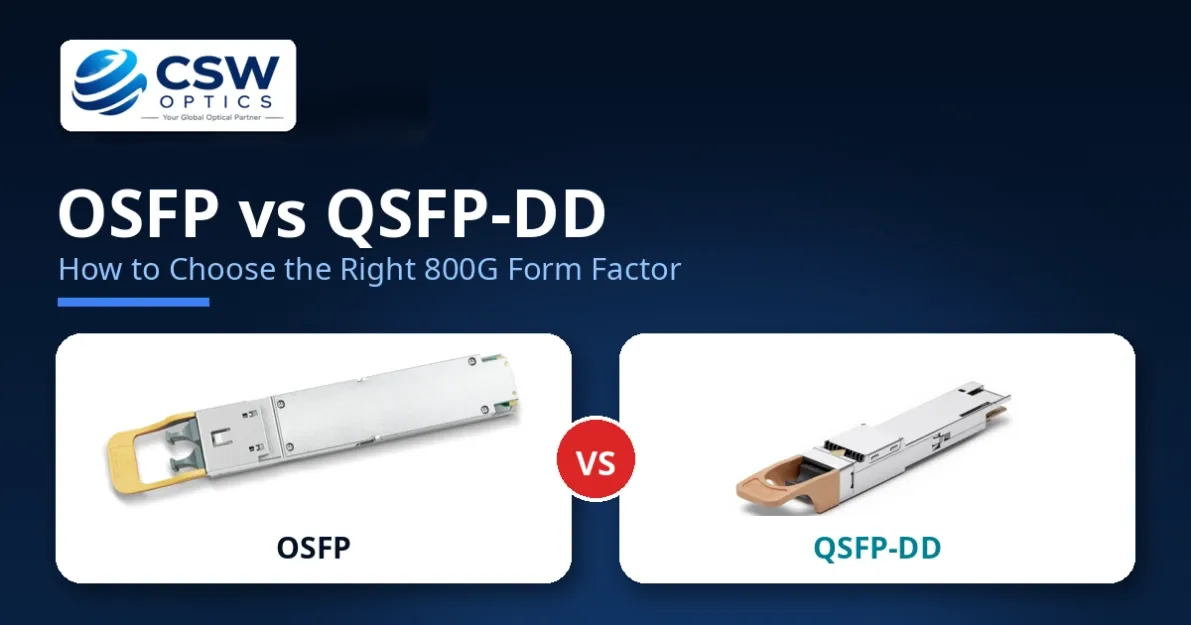
At 800G there are only two mainstream form factors, and the choice is made once. OSFP and QSFP-DD both carry 800G over eight 100G PAM4 lanes, both fit in a 1RU switch, and both are stocked by every major optics vendor. But a module built for one cage cannot plug into the other, and the switch you buy is built for one cage or the other. Choose the form factor when you choose the switch — by the time you are ordering modules, the decision is already made.
That is what makes this a decision article rather than a specification comparison. The optics are the same; the bodies, the power envelopes, the port counts and the upgrade paths are not. This article compares the two on the four points that actually change a purchase — size and density, power and heat, backward compatibility, and cabling — then gives a five-step check to run before you order.
One caution: the figures below are the MSA design envelopes and the IEEE standard reaches. Vendors implement them differently — one vendor's 800G-VR8 uses an MPO-12 connector, another's an MPO-16 — so confirm the exact module in its datasheet and your switch's compatibility matrix before ordering.
The Same 800G, Two Different Bodies
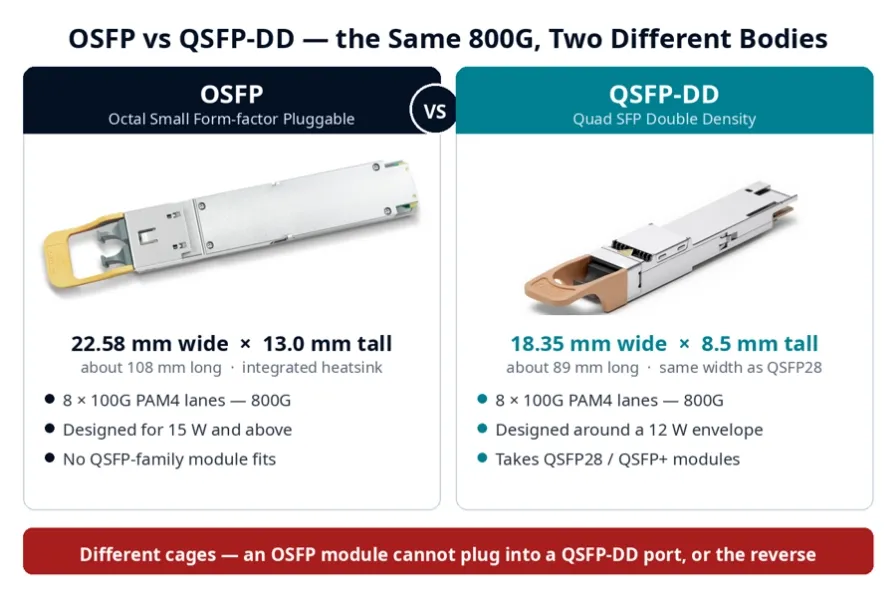
OSFP (Octal Small Form-factor Pluggable) is the newer design, built from a blank sheet for 800G and beyond. It is 22.58 mm wide, 13.0 mm tall and about 108 mm long, with an integrated heatsink and the thermal headroom to dissipate 15 W and more. QSFP-DD (Quad Small Form-factor Pluggable Double Density) is the evolutionary design: it doubles the QSFP28's lanes to eight while keeping the exact same 18.35 mm width, 8.5 mm height and roughly 89 mm length, so it stays backward compatible with the QSFP family. The two take different routes to the same 800G — one buys headroom with size, the other buys continuity with compatibility.
| Attribute | OSFP | QSFP-DD |
|---|---|---|
| Full name | Octal Small Form-factor Pluggable | Quad SFP Double Density |
| Width × height | 22.58 mm × 13.0 mm | 18.35 mm × 8.5 mm |
| Length | About 108 mm | About 89 mm |
| Electrical lanes | 8 | 8 |
| 800G signalling | 8 × 100G PAM4 | 8 × 100G PAM4 |
| Backward compatibility | None — no QSFP-family module fits | Takes QSFP28 and QSFP+ modules |
| 1RU port density (typical) | 32 ports | 36 ports |
| Power envelope (MSA design) | 15 W and above, headroom to 25 W+ | Around 12 W, stretched to about 15 W for 800G |
| Integrated heatsink | Yes | No — relies on the cage and system airflow |
| 1.6T path | OSFP-XD defined, same cage | QSFP-DD800 / next generation still maturing |
The extra 4.23 mm of width is the whole story. It gives OSFP roughly twice the internal volume, room for a heatsink on the module itself, and a power envelope that keeps growing — which is why the hyperscalers building AI clusters, where every rack is a thermal problem, standardised on it. QSFP-DD spends the same width budget differently: it keeps the QSFP footprint every enterprise data centre already has, so the same faceplate, the same spares shelf and the same installation practice carry over from 100G and 400G.
Density: Four Ports per Rack Unit
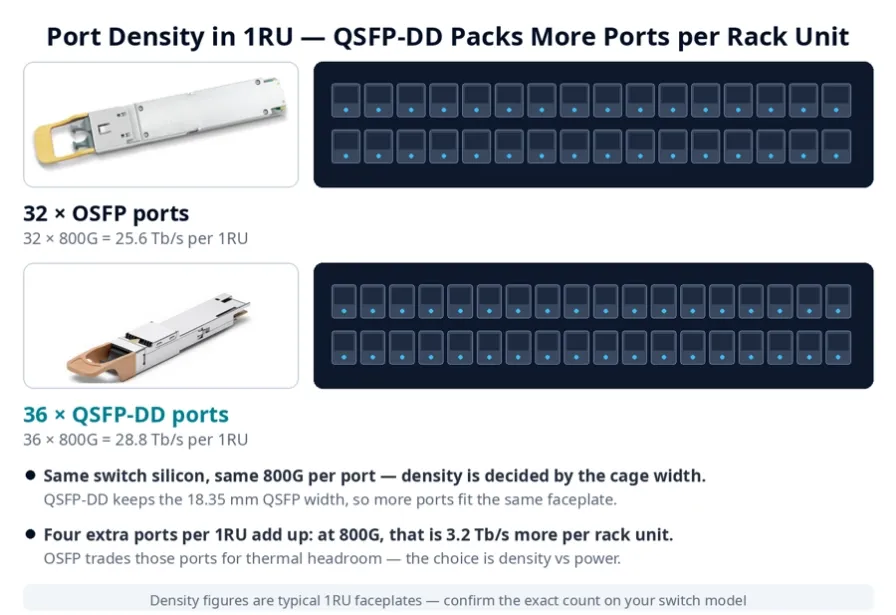
Same switch silicon, same 800G per port — density is decided by the cage width. A typical 1RU faceplate holds 32 OSFP ports or 36 QSFP-DD ports. At 800G per port that is 25.6 Tb/s against 28.8 Tb/s per rack unit, a 3.2 Tb/s difference that compounds across a row of racks: four extra ports per switch, and a spine layer that needs fewer switches to reach the same total bandwidth.
That is the honest trade, and it cuts both ways. QSFP-DD wins the density argument on paper; OSFP trades those four ports for thermal headroom. If your constraint is ports per rack and your modules are standard Ethernet reaches, QSFP-DD's density is real money. If your constraint is watts per module — coherent optics, or a roadmap that runs through 1.6T — the four ports are the price of the headroom. Neither side wins in the abstract; the winner is whichever constraint binds your deployment.
Power and Heat: Where OSFP Earns Its Size
Every 800G module has to shed the heat of eight 100G PAM4 lanes plus a DSP. Most standard 800G Ethernet modules sit under 15 W — NVIDIA's own 800G OSFP range, for example, is listed under 15 W — so both form factors can carry them. The difference shows at the edges: QSFP-DD was designed in the 400G era for a 12 W envelope and is stretched to about 15 W at 800G, which means tight thermal interface design and strong faceplate airflow; OSFP was designed from day one for 15 W and above, with headroom to 25 W and more, and carries its own heatsink.
That headroom is what coherent optics need. A coherent ZR or ZR+ module, with its DSP and laser running at metro reaches, is a 15–25 W device — at the edge of what a QSFP-DD cage can cool, and comfortably inside what OSFP was built for. If your 800G plan includes coherent ZR, or a 1.6T step on the same cage, OSFP is not a preference, it is a requirement. If your 800G plan is Ethernet reaches only — SR, DR, FR and their 2×400G variants — both cages are thermally adequate, and the choice moves back to density and upgrade path.
There is a practical footnote to the QSFP-DD power story. "Stretched to about 15 W" does not mean every 800G QSFP-DD module runs at 15 W in every switch: it means the cage and the switch's airflow were validated for it. A QSFP-DD800 module in a switch whose faceplate airflow was designed for 400G-era power will throttle, alarm, or simply not be on the vendor's supported-module list. So the power check is not a form-factor check alone — it is a three-way check between the module's power class, the switch model's airflow, and the vendor's supported list for your software release. The same applies to OSFP, but the margin is larger, so the check fails less often.
| Attribute | QSFP-DD | OSFP |
|---|---|---|
| MSA design power envelope | Around 12 W, stretched to about 15 W for 800G | 15 W and above, headroom to 25 W+ |
| 800G Ethernet modules (SR / DR / FR) | Fits — most sit under 15 W | Fits, with margin to spare |
| Coherent ZR / ZR+ optics | At the edge of the envelope — few options | The natural home for high-power coherent |
| Cooling at 800G | Needs strong faceplate airflow | Integrated heatsink plus more surface area |
| 1.6T outlook | Path still maturing | OSFP-XD defined, same cage |
Backward Compatibility and the Upgrade Path
This is the section that decides most enterprise purchases, because it is about the equipment already in the building. A QSFP-DD port accepts QSFP28 and QSFP+ modules, so a 100G QSFP28 module works in an 800G QSFP-DD switch, and a 400G QSFP-DD module runs at 400G in the same port. Your 400G estate is not stranded by an 800G upgrade: the new switch takes the old modules, and you move ports to 800G one at a time, as budget and demand allow. That is also why QSFP-DD dominates mixed estates — a 400G QSFP-DD module, original, such as Cisco's QDD-400G-DR4-S, or a compatible coded for the platform, keeps working while 800G rolls out port by port.
OSFP offers no such path. Nothing from the QSFP family fits an OSFP cage, and an OSFP module fits nothing else. Moving to OSFP means a clean break: new switch, new modules, new spares, on the same day. Adapters exist that let a QSFP-DD module sit in an OSFP cage, but they are an extra part to buy, stock and troubleshoot, not a migration strategy. For a greenfield AI cluster that is a non-issue — everything is new anyway. For a data centre with three generations of QSFP hardware in production, it is the single largest cost in the decision, larger than any per-module price difference.
The background to the QSFP family's evolution — how QSFP-DD grew out of QSFP28 and what changed at 400G — is covered in our earlier guide to QSFP28 vs QSFP-DD. What matters here is the consequence at 800G: QSFP-DD lets you upgrade at the speed of your budget; OSFP requires a clean-cut migration.
Cabling Follows the Cage
The cage decision follows you into the cable tray, because every 800G cable is cage-specific. An 800G DAC or AOC built for OSFP will not plug into a QSFP-DD port, and the reverse — so a mixed estate needs two cable stocks, and a wrong-cage cable order is discovered at installation, not at the purchase order. Order cables against the switch's cage, not against the rate.
The fiber side splits by optical design, not by form factor. Parallel optics — SR8, DR8 and VR8 — run eight lanes over separate fibers and use an MPO connector, but which MPO depends on the vendor's design: some 800G parallel modules use MPO-12, others MPO-16, so check the module's datasheet rather than assuming from the reach code. WDM optics — FR4 and LR4 — multiplex four wavelengths onto one fiber pair and use duplex LC. And the 2×400G variants — 2FR4, 2LR4 and similar — are two independent 400G links inside one 800G module, usually on two duplex LC pairs: the far end needs two 400G ports, not one 800G port, so a 2FR4 module is a breakout device, not a single 800G link. Confirm which one you are buying before the fiber is pulled.
One more cabling detail that causes more failed 800G links than any other: MPO polarity and cleanliness. Parallel optics need the correct polarity — the transmit fibers on one end must land on the receive fibers on the other — and a 16-fiber MPO collects dust across sixteen end faces at once, so a single dirty connector can take down all eight lanes together where a dirty LC would take down one. Budget for MPO inspection and cleaning in the installation plan, and keep the polarity method (usually Type B for these links) the same at both ends of every run.
What 800G Looks Like on Our Shelves
The comparison above is about form factors; this table is about what you can actually order. Every 800G module here is a CSW Optics compatible module, coded for the switch platform named on its page. Our original Cisco range at this density is the 400G QSFP-DD family — there is no original 800G range on our shelves yet — so if your policy requires original modules, 400G QSFP-DD is the top of that range, and 800G is a compatible decision.
| Model | Form factor | Type | Reach | Connector |
|---|---|---|---|---|
| Cisco OSFP-800G-DR8 | OSFP | 800GBASE-DR8 | 500 m, SMF | MPO-12 |
| Cisco OSFP-800G-VR8 | OSFP | 800GBASE-VR8 | 50 m, OM4 MMF | MPO-12 |
| Cisco QDD-800G-VR8 | QSFP-DD | 800GBASE-VR8 | 50 m, OM4 MMF | MPO-12 |
| Huawei OSFP-800G-SR8 | OSFP | 800GBASE-SR8 | 100 m, OM4 MMF | MPO-16 |
| Huawei OSFP-800G-DR8 | OSFP | 800GBASE-DR8 | 500 m, SMF | MPO-12 |
| Huawei OSFP-800G-2FR4 | OSFP | 2 × 400GBASE-FR4 | 2 km, SMF | 2 × duplex LC |
| Arista OSFP-800G-VR8 | OSFP | 800GBASE-VR8 | 50 m, OM4 MMF | MPO-16 APC |
| Arista QDD-800G-2FR4 | QSFP-DD | 2 × 400GBASE-FR4 | 2 km, SMF | 2 × duplex LC |
NVIDIA's 800G range on our shelves is OSFP as well: the MMA4Z00-NS (800G SR8) and the MMS4X00-NM (800G DR8), both built for NVIDIA AI and HPC fabrics. And the 1.6T step is already listed — the MMS4A00-XM, a 1600GBASE-DR8 module in the same OSFP cage as today's 800G OSFP. That is the OSFP roadmap argument in one product line: the cage you buy for 800G today is the cage the 1.6T module fits tomorrow.
The Five-Step Check Before You Order
- Platform first. Which cage does your switch take — OSFP or QSFP-DD? Check the switch order and the vendor's compatibility matrix. No module can fix a wrong cage, and this is the one mistake that costs a switch, not a module.
- Native 800G or 2 × 400G? An 800G DR8/SR8/VR8 module is one 800G link; a 2FR4 or 2LR4 module is two 400G links. Match the module to what the far end actually has — two 400G ports, or one 800G port.
- Distance and fiber. VR8 reaches 50 m and SR8 100 m over OM4 multimode; DR8 reaches 500 m and FR4 2 km over single-mode. Judge by the fiber installed and its grade first, distance second, and leave margin.
- Power and cooling. Add up the modules' power against the switch's per-port budget and the faceplate airflow available. Standard Ethernet reaches fit either cage; coherent ZR needs OSFP headroom.
- Spares and coding. Keep spares in the same form factor and the same coding as the installed base — a compatible module must be coded for the exact switch model and software release, as with every other rate. One spare that fits the wrong cage is not a spare.
Talk to CSW Optics Before You Order
If you are choosing between OSFP and QSFP-DD for an 800G build, send us the switch model and the link plan before you commit. Tell us the platform, the distance and fiber type of each link, and whether any 400G modules need to keep working. We will confirm which cage your switch takes, whether an original 400G QSFP-DD module or a CSW Optics compatible 800G module coded for that platform is the right fit for each link, and flag any 2×400G or MPO variant worth double-checking.
Get a Quote via our Contact page — include the switch model in your message so we can check the match, not just the price.