
Jun 26, 2026News Center
Why Do 100G, 400G and 800G Networks Rely on Optical Transceivers?
Learn why optical transceivers are essential for 100G, 400G and 800G networks. Explore transmission distance, power efficiency, port density, AI data center requirements, and popular QSFP28, QSFP-DD
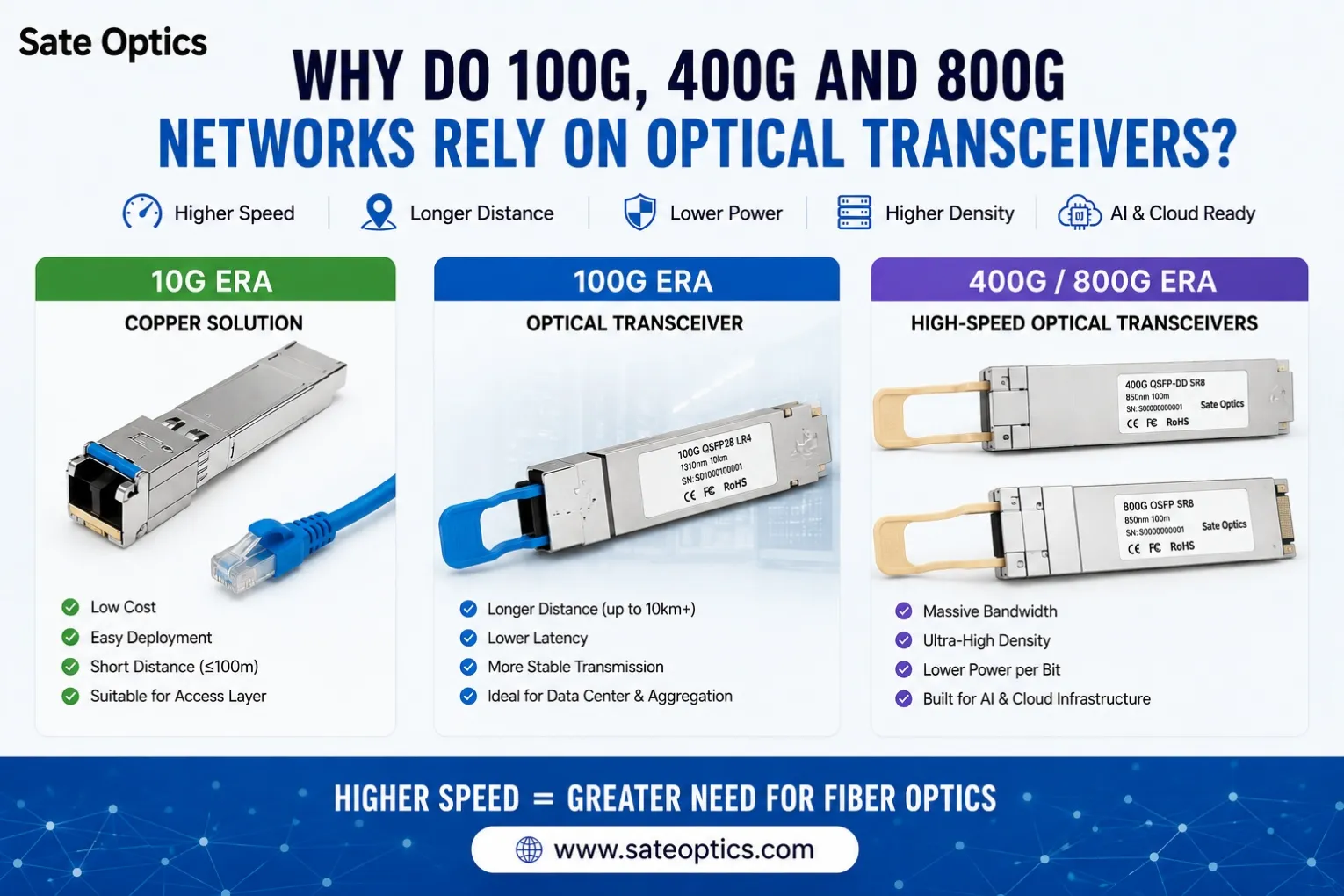
As modern networks continue to evolve, bandwidth demand is growing faster than ever.
Cloud computing, artificial intelligence (AI), machine learning, video streaming, and hyperscale data centers are generating massive amounts of data traffic every second.
While copper cabling worked well for traditional 1G and 10G networks, today's 100G, 400G, and even 800G infrastructures increasingly rely on optical transceivers.
But why has fiber optics become the preferred technology for high-speed networking?
Let's explore the key reasons.
The Evolution from 10G to 800G Networks
A decade ago, many enterprise networks operated comfortably at:
- 1G Ethernet
- 10G Ethernet
Today, data centers are rapidly deploying:
- 25G Server Connections
- 100G Spine Networks
- 400G Data Center Fabrics
- 800G AI Clusters
As bandwidth increases, maintaining signal quality becomes increasingly difficult with traditional electrical transmission methods.
This is where optical transceivers play a critical role.
1. Optical Transceivers Support Much Longer Distances
One of the biggest limitations of copper cabling is transmission distance.
As data rates increase, electrical signals experience:
- Signal attenuation
- Electromagnetic interference (EMI)
- Crosstalk
- Higher error rates
Fiber optics transmit data using light rather than electrical signals, allowing significantly longer transmission distances.
Typical optical transceiver reach includes:
Module Type | Distance |
|---|---|
100G SR4 | 70-100m |
100G LR4 | 10km |
400G DR4 | 500m |
400G FR4 | 2km |
400G LR4 | 10km |
800G DR8 | 500m |
100G BIDI | 10km-80km |
Even over long distances, fiber maintains excellent signal quality.
2. Higher Speeds Require Better Signal Integrity
At 100G and beyond, even minor signal degradation can affect network performance.
Fiber optic transmission offers:
✔ Lower bit error rates
✔ Reduced latency
✔ Minimal signal loss
✔ Better resistance to interference
This makes optical modules ideal for mission-critical applications where reliability is essential.
For example, AI training clusters often require thousands of high-speed links operating continuously with near-zero packet loss.
3. Optical Technology Improves Power Efficiency
Power consumption has become one of the largest operating costs for modern data centers.
Large cloud facilities may contain:
- Tens of thousands of servers
- Thousands of switch ports
- Hundreds of terabits of aggregate bandwidth
As speeds increase from 100G to 400G and 800G, energy efficiency becomes increasingly important.
Modern optical transceivers are designed to deliver:
- Higher bandwidth
- Lower power per transmitted bit
- Better thermal performance
This helps operators reduce both energy costs and cooling requirements.
4. Optical Transceivers Enable High Port Density
Today's data center switches support extremely high port densities.
Examples include:
- 32 × 400G QSFP-DD ports
- 64 × 400G QSFP-DD ports
- 32 × 800G OSFP ports
Without compact optical transceivers, achieving such density would be nearly impossible.
The small form factors allow operators to maximize bandwidth while minimizing rack space.
5. AI and Cloud Computing Are Accelerating Bandwidth Growth
Artificial intelligence has dramatically changed data center networking requirements.
Modern AI clusters generate enormous east-west traffic between:
- GPUs
- Storage systems
- Compute nodes
- Network fabrics
Applications driving optical deployment include:
AI Training Clusters
High-speed interconnects are required between GPU servers.
Hyperscale Data Centers
Cloud providers need scalable 400G and 800G architectures.
Data Center Interconnect (DCI)
Long-distance fiber links connect multiple facilities.
Telecom Backbone Networks
Service providers rely on optical technologies for high-capacity transport.
The result is a growing demand for advanced optical transceivers.
Common Optical Transceivers Used in Modern Networks
100G Optical Modules
Popular models include:
- QSFP-100G-SR4-S
- QSFP-100G-LR4-S
- QSFP-100G-CWDM4-S
- QSFP-100G-DR-S
- QSFP-100G-SM-SR=
Applications:
- Enterprise data centers
- Campus networks
- Telecom aggregation
400G Optical Modules
Popular models include:
- QSFP-DD 400G SR8
- QSFP-DD 400G DR4
- QSFP-DD 400G FR4
- QSFP-DD 400G LR4
Applications:
- Hyperscale cloud data centers
- AI infrastructure
- Spine-leaf architectures
800G Optical Modules
Popular models include:
- OSFP 800G SR8
- OSFP 800G DR8
- QSFP-DD800 SR8
- QSFP-DD800 DR8
Applications:
- AI clusters
- High-performance computing (HPC)
- Next-generation cloud infrastructure
Real-World Application Scenarios
Scenario 1: Enterprise Data Center Upgrade
A company upgrading from 10G to 100G can use:
- QSFP28 SR4 modules
- MPO fiber cabling
Benefits:
- Higher throughput
- Improved scalability
- Future-proof architecture
Scenario 2: Hyperscale Cloud Network
Cloud providers deploying 400G fabrics often choose:
- QSFP-DD DR4
- QSFP-DD FR4
Benefits:
- Reduced power consumption
- Higher switch utilization
- Lower total cost of ownership
Scenario 3: AI Training Infrastructure
AI clusters commonly deploy:
- 800G OSFP DR8
- 800G OSFP SR8
Benefits:
- Ultra-high bandwidth
- Low latency communication
- Faster model training
Why Optical Transceivers Are Essential for Future Networks
The networking industry is moving toward:
- 100G Everywhere
- 400G Mainstream Deployment
- 800G AI Networks
- 1.6T Future Infrastructure
Without optical transceivers, achieving these speeds at scale would not be practical.
Fiber optics provide the performance, scalability, and efficiency needed for modern digital infrastructure.
FAQ
Why can't copper cables replace optical transceivers in 400G and 800G networks?
Copper cables can support very short distances, but signal degradation, power consumption, and size limitations become significant challenges at 400G and 800G speeds.
Which optical module is most commonly used for 100G networks?
The most widely deployed options are:
- QSFP28 SR4
- QSFP28 LR4
- QSFP28 CWDM4
The choice depends on transmission distance and fiber type.
Are 400G optical transceivers suitable for enterprise networks?
Yes. Many enterprises are adopting 400G networks to support cloud computing, virtualization, and data-intensive applications.
What is the difference between QSFP-DD and OSFP?
Both support 400G and 800G transmission.
OSFP generally offers better thermal performance, while QSFP-DD provides backward compatibility with existing QSFP form factors.
Will 800G become the new standard?
800G deployment is rapidly increasing, especially in AI and hyperscale data centers. Industry adoption is expected to continue growing over the next several years.
Related Articles
SFP vs SFP+ vs SFP28: What's the Difference?
Understand the evolution from 1G to 25G optical modules and learn how to select the right transceiver for your network upgrade.
Singlemode vs Multimode Fiber Explained
Compare transmission distance, cost, and deployment scenarios to determine the best fiber type for your application.
Cisco SFP-10G-SR vs SFP-10G-LR
Learn the differences between short-reach and long-reach 10G optical modules and how fiber selection impacts performance.
AOC vs DAC vs Optical Modules
Explore the advantages and limitations of each connectivity option in modern data centers.
How to Choose Optical Transceivers
A complete buyer's guide covering compatibility, transmission distance, wavelength, connector type, and deployment scenarios.
CTA
Planning a 100G, 400G or 800G Network Upgrade?
Sate Optics provides a complete portfolio of:
✅ 100G QSFP28 Optical Transceivers
✅ 400G QSFP-DD Optical Modules
✅ 800G OSFP & QSFP-DD800 Solutions
✅ DAC & AOC Cables
✅ MPO Fiber Connectivity
✅ OEM-Compatible Optical Transceivers for Cisco, Arista, Juniper, Huawei, Nokia and more
Our technical team can help you select the most cost-effective solution based on your transmission distance, switch platform, and application requirements.
Contact Sate Optics today for expert guidance and competitive pricing on your next high-speed network deployment. 🚀