
Jun 26, 2026News Center
Enterprise Network Infrastructure Solutions for Modern Businesses
Learn how enterprises build scalable, reliable, and future-ready network infrastructure with switches, optical transceivers, DAC/AOC cables, and data center solutions.
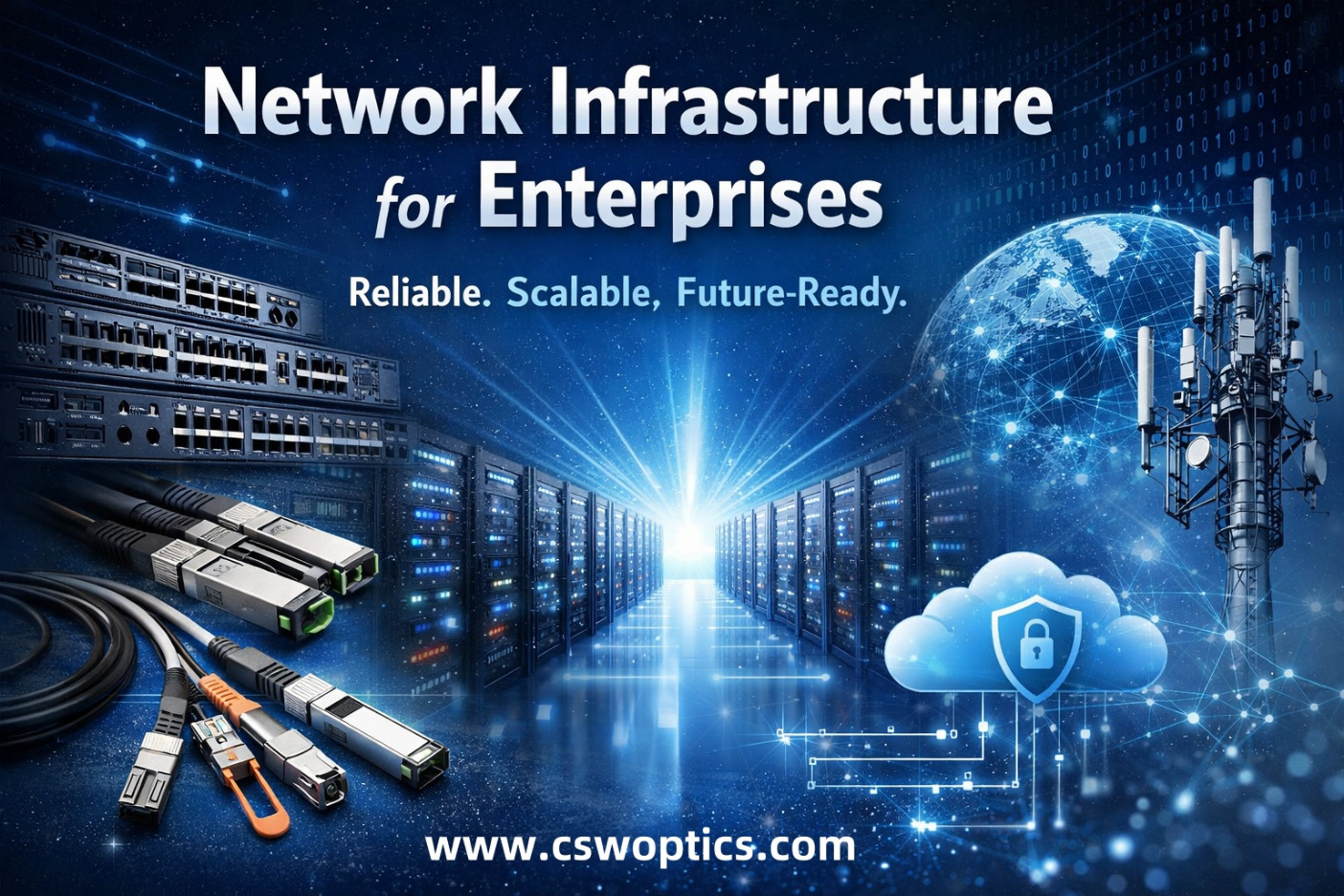
Network Infrastructure for Enterprises
Building a Reliable, Scalable, and Future-Ready Enterprise Network
Modern enterprises rely on fast, stable, and secure networks more than ever before.
Whether it’s cloud computing, AI workloads, video conferencing, cybersecurity, or remote collaboration, every digital operation depends on strong network infrastructure.
But building enterprise network infrastructure is not simply about buying switches or optical modules.
The real challenge is:
- How to ensure long-term stability?
- How to avoid compatibility issues?
- How to support future upgrades?
- How to balance performance and budget?
- How to minimize downtime risks?
In this guide, we’ll explain how enterprise network infrastructure works, what components matter most, and how businesses can build networks that are reliable, scalable, and cost-effective.
What Is Enterprise Network Infrastructure?
Enterprise network infrastructure refers to the complete system that connects devices, servers, applications, and users together.
It typically includes:
- Ethernet switches
- Routers
- Firewalls
- Optical transceivers
- DAC/AOC cables
- Structured cabling
- Wireless access points
- Data center interconnects
- Network management systems
Together, these components create the foundation for:
✔ Data communication
✔ Cloud access
✔ Internet connectivity
✔ Internal business operations
✔ Cybersecurity enforcement
✔ Data center networking
Without reliable infrastructure, even powerful applications cannot perform properly.
Why Enterprise Networks Are Becoming More Complex
Traditional office networks were relatively simple.
Today’s enterprise environments are very different.
Modern businesses now require:
- Higher bandwidth
- Lower latency
- Remote workforce connectivity
- Multi-cloud integration
- AI and big data support
- Real-time applications
- Stronger cybersecurity
- 24/7 uptime
As a result, enterprise networks must support:
Requirement | Impact on Infrastructure |
|---|---|
Cloud Computing | Higher east-west traffic |
AI Workloads | Massive bandwidth demand |
Video Collaboration | Low latency requirements |
Remote Work | Secure VPN and firewall expansion |
Data Centers | High-density optical connectivity |
Cybersecurity | Advanced segmentation and monitoring |
This is why many companies are upgrading from:
- 1G → 10G
- 10G → 25G
- 40G → 100G
- 100G → 400G
Network infrastructure is no longer just IT equipment.
It has become critical business infrastructure.
Core Components of Enterprise Network Infrastructure
1. Enterprise Switches
Switches are the backbone of enterprise networks.
They connect:
- Servers
- PCs
- Storage systems
- Wireless APs
- Firewalls
- Data center devices
Common enterprise switch brands include:
- Cisco
- Juniper
- Arista
- HPE
- Huawei
- Fortinet
When choosing switches, enterprises usually focus on:
Key Concerns
- Port density
- Layer 2/Layer 3 support
- Redundancy
- Power efficiency
- Stacking capability
- Throughput
- Future scalability
A common mistake is buying switches only for current demand instead of future growth.
2. Optical Transceivers
Optical transceivers are essential for high-speed data transmission.
They convert electrical signals into optical signals for fiber communication.
Common form factors include:
- SFP
- SFP+
- SFP28
- QSFP+
- QSFP28
- QSFP-DD
- OSFP
Applications include:
- Data centers
- Enterprise backbone networks
- Campus networks
- Cloud infrastructure
Why Optical Modules Matter
Many network failures actually originate from poor-quality optical modules.
Common issues include:
- Compatibility alarms
- Link instability
- High packet loss
- Overheating
- CRC errors
- Short transmission distance
- High power consumption
This is why enterprises increasingly prefer:
- Fully compatible coded transceivers
- Industrial-grade testing
- DDM/DOM monitoring support
- Low failure rate products
Reliable optical modules help reduce:
✔ Downtime
✔ Maintenance costs
✔ Network troubleshooting time
3. DAC and AOC Cables
For short-distance connections inside racks or data centers, DAC and AOC solutions are widely used.
DAC (Direct Attach Cable)
Best for:
- Low-cost short-range connections
- Top-of-rack deployments
- Low power consumption
AOC (Active Optical Cable)
Best for:
- Longer distances
- Lightweight cabling
- Better EMI resistance
Choosing between DAC and AOC depends on:
- Distance
- Heat management
- Cable density
- Budget
- Flexibility requirements
Common Enterprise Network Challenges
Compatibility Problems
One of the biggest enterprise pain points is compatibility.
Examples:
- “Unsupported transceiver” alarms
- Port shutdowns
- Firmware mismatches
- Vendor lock-in restrictions
This is especially common with:
- Cisco
- Arista
- Juniper
- Fortinet
Reliable suppliers usually provide:
✔ Vendor-coded EEPROM
✔ Compatibility testing
✔ Firmware validation
✔ Multi-brand support
Scalability Issues
Many enterprises underestimate future bandwidth growth.
A network designed only for current traffic may become outdated within 1–2 years.
Scalable infrastructure should support:
- Future port expansion
- Higher-speed migration
- Modular architecture
- Flexible uplink upgrades
For example:
- 10G today
- 25G tomorrow
- 100G aggregation later
Good planning reduces future replacement costs.
Downtime Risks
Network downtime is extremely expensive.
Even a short outage can affect:
- Customer operations
- Cloud services
- Internal communications
- Security systems
- Revenue generation
To reduce risks, enterprises usually deploy:
- Redundant links
- Backup power
- Hot-swappable modules
- Dual-core architecture
- Monitoring systems
Stable infrastructure is not optional anymore.
It is a business necessity.
How Enterprises Can Reduce Network Costs Without Sacrificing Reliability
Many businesses assume lower cost means lower quality.
That is not always true.
Today, many enterprises use:
- Compatible optical transceivers
- Third-party DAC/AOC cables
- Refurbished enterprise switches
- Hybrid infrastructure strategies
The key is choosing suppliers with:
✔ Strict testing procedures
✔ Real compatibility validation
✔ Stable supply capability
✔ Technical support
✔ Consistent product quality
Low-cost products without testing often create higher long-term maintenance costs.
Future Trends in Enterprise Network Infrastructure
1. 400G and 800G Migration
AI and cloud computing are accelerating high-speed upgrades.
400G deployment is already expanding rapidly in:
- Hyperscale data centers
- Cloud providers
- AI clusters
800G infrastructure is also beginning to enter large-scale deployment planning.
2. AI-Driven Networks
AI is changing how networks operate.
Future enterprise networks will increasingly use:
- Predictive monitoring
- Automated troubleshooting
- Intelligent traffic optimization
- AI-assisted security analysis
3. Higher Fiber Density
As bandwidth grows, data centers require:
- Higher port density
- Better airflow
- Lower power consumption
This drives demand for:
- QSFP-DD
- OSFP
- High-density patch panels
- Advanced cable management
How to Choose the Right Network Infrastructure Partner
A good supplier should provide more than products.
They should also help with:
- Compatibility advice
- Network planning
- Customized solutions
- Stable delivery
- Technical troubleshooting
- Long-term support
Before purchasing, enterprises should ask:
Important Questions
- Are the modules fully tested?
- Which switch brands are supported?
- Is DDM monitoring available?
- Can firmware be customized?
- Is there batch consistency control?
- What warranty and support are included?
- Can future upgrades be supported?
Reliable support often matters more than the lowest price.
Final Thoughts
Enterprise network infrastructure is the foundation of modern digital business.
The right infrastructure improves:
✔ Performance
✔ Reliability
✔ Security
✔ Scalability
✔ Operational efficiency
The wrong infrastructure creates:
✖ Downtime
✖ Compatibility problems
✖ High maintenance costs
✖ Limited scalability
Whether deploying campus networks, enterprise backbones, or modern data centers, businesses should focus on long-term reliability instead of short-term savings alone.
With proper planning and reliable networking solutions, enterprises can build infrastructure ready for future growth.
FAQ
What is enterprise network infrastructure?
Enterprise network infrastructure is the complete system of networking hardware and connectivity solutions that support business communication, data transmission, cloud access, and cybersecurity.
Why are optical transceivers important in enterprise networks?
Optical transceivers enable high-speed fiber communication between switches, routers, and servers. Reliable modules help ensure stable network performance and reduce downtime.
What is the difference between DAC and AOC cables?
DAC cables use copper for short-range connections and are cost-effective. AOC cables use optical fiber and support longer distances with lower interference.
Can compatible transceivers work with Cisco or Fortinet switches?
Yes. Properly coded compatible transceivers can work reliably with many major brands including Cisco, Fortinet, Juniper, Arista, and others.
How can enterprises prepare for future bandwidth growth?
Enterprises should choose scalable infrastructure that supports higher-speed upgrades such as 25G, 100G, 400G, and future expansion requirements.
Need Reliable Enterprise Networking Solutions?
SATE offers:
- Optical transceivers
- DAC & AOC cables
- Enterprise networking solutions
- Multi-brand compatibility
- Customized coding services
- Stable supply support
Whether you need original or compatible networking products, our team can help build reliable and scalable infrastructure for your business.
👉 Contact us today to discuss your network requirements.