
Jun 26, 2026News Center
Compatible Optics vs Original Optics — What’s the Real Difference?
Original vs compatible optics? The real difference is testing, reliability, and compatibility — not just the label. Many networks now choose compatible optics for stable performance and lower costs.
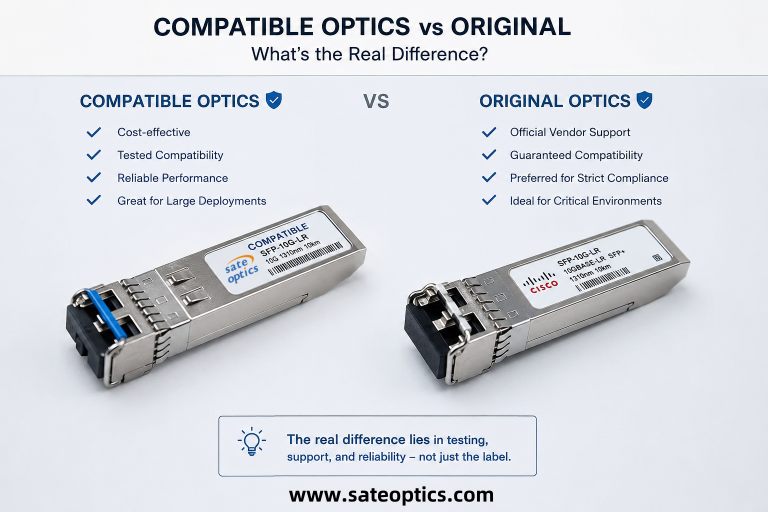
Many IT teams still ask the same question before buying optical transceivers:
“Should we use original optics or compatible optics?”
The short answer:
👉 Both can work very well.
👉 The real difference is usually price, testing standards, support, and supplier quality — not simply the label on the module.
Here’s a simple and practical breakdown 👇
What Are Original Optics?
Original optics are transceivers sold directly by major network equipment brands like Cisco, Juniper, Arista, Huawei, etc.
They are designed and branded by the equipment vendor and officially supported within their ecosystem.
Typical advantages:
- Official vendor branding
- Vendor warranty/support
- Guaranteed compatibility with their own hardware
- Often preferred in highly regulated environments
But there’s one thing many buyers notice quickly:
💰 The price is usually much higher.
In many cases, the hardware inside may come from the same OEM/ODM manufacturing ecosystem used across the optical industry.
What Are Compatible Optics?
Compatible optics are third-party transceivers programmed and tested to work with specific switch/router platforms.
A good compatible module is typically:
- MSA compliant
- Compatibility tested
- EEPROM programmed for target platforms
- Performance tested before shipment
Today, compatible optics are widely used in:
- Data centers
- ISPs
- Enterprise networks
- CCTV systems
- Telecom projects
- Cloud infrastructure
Especially when companies need to scale networks without exploding budgets.
The Biggest Difference Is NOT What Most People Think
Many people assume:
Original = high quality Compatible = low quality
But in real deployments, the situation is often more nuanced.
The real difference usually depends on:
1. Testing Quality
A well-tested compatible module can perform extremely reliably.
A poorly tested module — original or compatible — can still create issues.
Good suppliers usually perform:
- Compatibility testing
- DOM/DDM verification
- Temperature testing
- Link stability testing
- Switch interoperability testing
This matters more than the sticker.
2. Supplier Reliability
Not all compatible optics are equal.
Some factories focus on long-term quality control.
Others compete only on the lowest possible price.
That’s why network engineers often care more about:
- Failure rate
- Consistency
- Technical support
- Compatibility experience
- Warranty response
rather than simply “original vs compatible.”
3. Cost Efficiency
This is where compatible optics become very attractive.
For large deployments, the savings can be massive.
Example:
A data center deploying hundreds of 10G/25G/100G optics may reduce networking costs significantly by using reliable compatible transceivers.
That budget can then be used for:
- Additional redundancy
- Faster upgrades
- Better switching infrastructure
- Expansion projects
Will Compatible Optics Damage Switches?
This is one of the most common myths.
A properly designed and standards-compliant optical transceiver should not damage networking equipment.
Most compatibility concerns are related to:
- EEPROM recognition
- Vendor lock policies
- Firmware checks
- Stability under certain conditions
—not physical damage.
The key is using modules from reliable suppliers that perform real interoperability testing.
Why More Companies Are Using Compatible Optics
The industry has changed a lot over the last few years.
Modern compatible optics are now commonly used because companies want:
- Faster deployment
- Lower operational costs
- Multi-vendor flexibility
- Easier inventory management
- Better upgrade scalability
Especially in 25G / 100G / 400G environments, cost optimization becomes very important.
So… Which One Should You Choose?
There’s no single answer for every network.
Original optics may make sense if:
- Your policy requires official vendor support
- You work in highly sensitive environments
- Compliance rules are strict
- Procurement standards require OEM parts
Compatible optics may make sense if:
- You want better cost efficiency
- You manage multi-vendor networks
- You need scalable deployments
- You work with a trusted optics supplier
In many real-world networks today, both are used together.
Final Thoughts
The discussion is no longer simply:
“Original vs Compatible”
The smarter question today is:
✅ “Is the optic properly tested?”
✅ “Is the supplier reliable?”
✅ “Does it perform consistently in production environments?”
Because in networking, stability matters more than branding alone.
#OpticalTransceiver #CompatibleOptics #DataCenter #Networking #FiberOptics #Cisco #Juniper #Arista #Telecom #CloudInfrastructure #25G #100G #400G #NetworkEngineering #OpticalNetworking