
Jun 26, 2026News Center
10G SR vs LR vs ER vs ZR – Optical Transceiver Distance Comparison Guide
Compare 10GBASE-SR, LR, ER, and ZR optical transceivers by distance, fiber type, and application. Find the right 10G module for your network deployment.
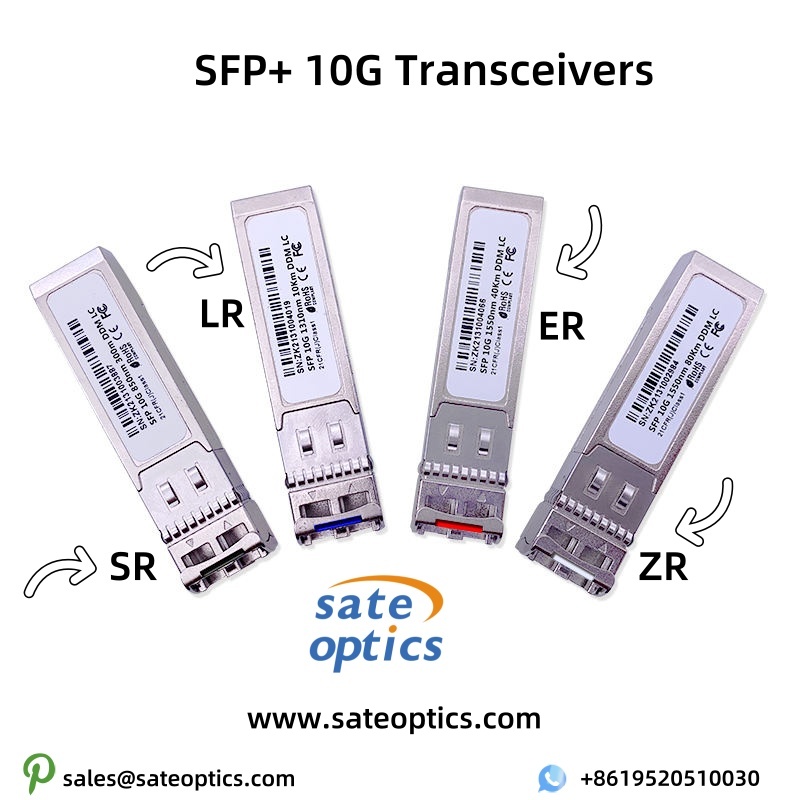
10G Distance Comparison Guide: SR vs LR vs ER vs ZR
When deploying a 10G network, choosing the right optical transceiver is critical. The main difference between SR, LR, ER, and ZR modules lies in transmission distance, fiber type, wavelength, and use case.
This quick guide helps you select the right solution based on your real deployment scenario.
Quick Comparison Overview
Type | Standard | Wavelength | Fiber Type | Max Distance | Typical Use Case |
|---|---|---|---|---|---|
SR | 10GBASE-SR | 850nm | MMF | Up to 300m | Data centers, short links |
LR | 10GBASE-LR | 1310nm | SMF | Up to 10km | Campus networks |
ER | 10GBASE-ER | 1550nm | SMF | Up to 40km | Metro networks |
ZR | 10GBASE-ZR | 1550nm | SMF | Up to 80km | Long-haul / telecom |
10GBASE-SR (Short Range)
Best for short-distance, high-density environments
- Uses multimode fiber (MMF)
- Low cost and low power consumption
- Ideal for in-rack and inter-rack connections
Typical scenarios:
- Data centers
- Server-to-switch links
- Top-of-rack (ToR) deployments
👉 If your distance is within 300m, SR is the most cost-effective choice.
10GBASE-LR (Long Range)
Best for medium-distance single-mode deployments
- Uses single-mode fiber (SMF)
- Supports up to 10km transmission
- Balanced cost vs performance
Typical scenarios:
- Campus backbone
- Building-to-building connections
- Enterprise networks
👉 LR is the most widely used 10G optical module.
10GBASE-ER (Extended Range)
Designed for metro and longer-distance links
- Operates over SMF at 1550nm
- Supports up to 40km
- Higher optical power and sensitivity
Typical scenarios:
- Metropolitan Area Networks (MAN)
- ISP infrastructure
- Long-distance enterprise connectivity
👉 Choose ER when LR distance is not enough.
10GBASE-ZR (Extended Long Range)
For ultra-long-distance transmission
- Industry-standard (not IEEE-defined)
- Supports up to 80km over SMF
- Requires careful link budget planning
Typical scenarios:
- Telecom backbone
- Data center interconnect (DCI)
- Regional network infrastructure
👉 ZR is ideal for long-haul applications, but may require:
- Optical amplifiers
- Dispersion compensation
How to Choose the Right 10G Module
Use this simple rule:
- ≤ 300m → SR
- ≤ 10km → LR
- ≤ 40km → ER
- ≤ 80km → ZR
But also consider:
- Fiber type (MMF vs SMF)
- Budget constraints
- Power consumption
- Future scalability
Pro Tips (From Real Deployments)
- SR is cheapest, but only works with MMF
- LR is the safest default choice for most networks
- ER/ZR require cleaner fiber and better planning
- Always check:
- Connector type (LC)
- Switch compatibility
- Digital diagnostics (DDM support)
Explore our compatible modules:
- SFP-10G-SR (Short Range)
- SFP-10G-LR (10km)
- SFP-10G-ER (40km)
- SFP-10G-ZR (80km)
10G SR vs LR vs ER vs ZR, 10GBASE-SR vs LR vs ER vs ZR, 10G optical module distance comparison, SR LR ER ZR difference, which 10G transceiver to choose, 10G fiber module guide